

Bare-Hand Combat
The techniques of Bare-handed Combat (Verum Kai) are approached in a principial manner rather than by strictly following the formal curriculum of each of the styles studied. I also integrate what I have drawn from from other martial disciplines I have had occasion to practise. The nature of our techniques is such that it is not truly possible to train in free fighting as in “boxing sparring.” This said, the training methods are conceived so that one can inhabit the full intensity of the strikes and to reach maximum speed of execution (according to the aptitudes of one’s partner), following codified patterns. This avoids the risk of injury, develops self-control, and also provides the opportunity for emotional work and conditioning to impact.
This theme is rather reserved for practitioners of martial arts and combat sports who wish to concentrate on martial efficacy, but it remains open and useful to all when it is a matter of learning to know oneself and to manage one’s emotional patterns in a relationship under tension.
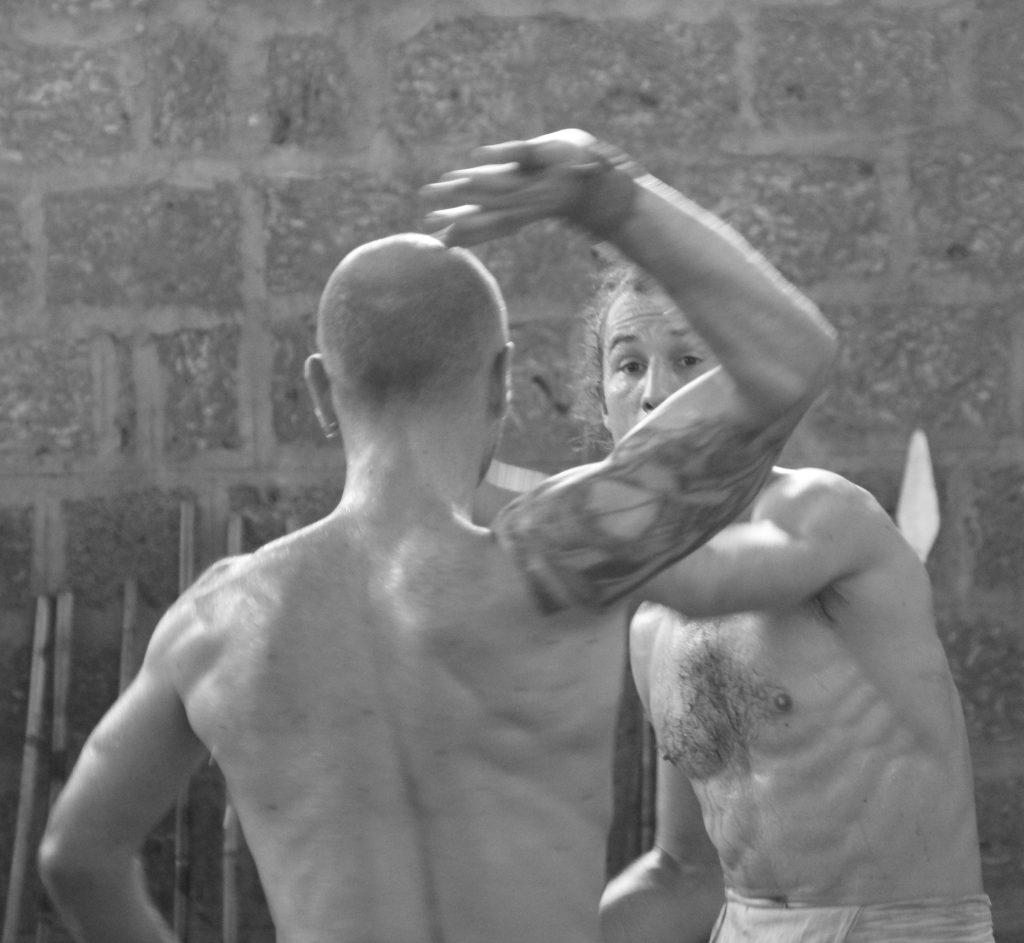
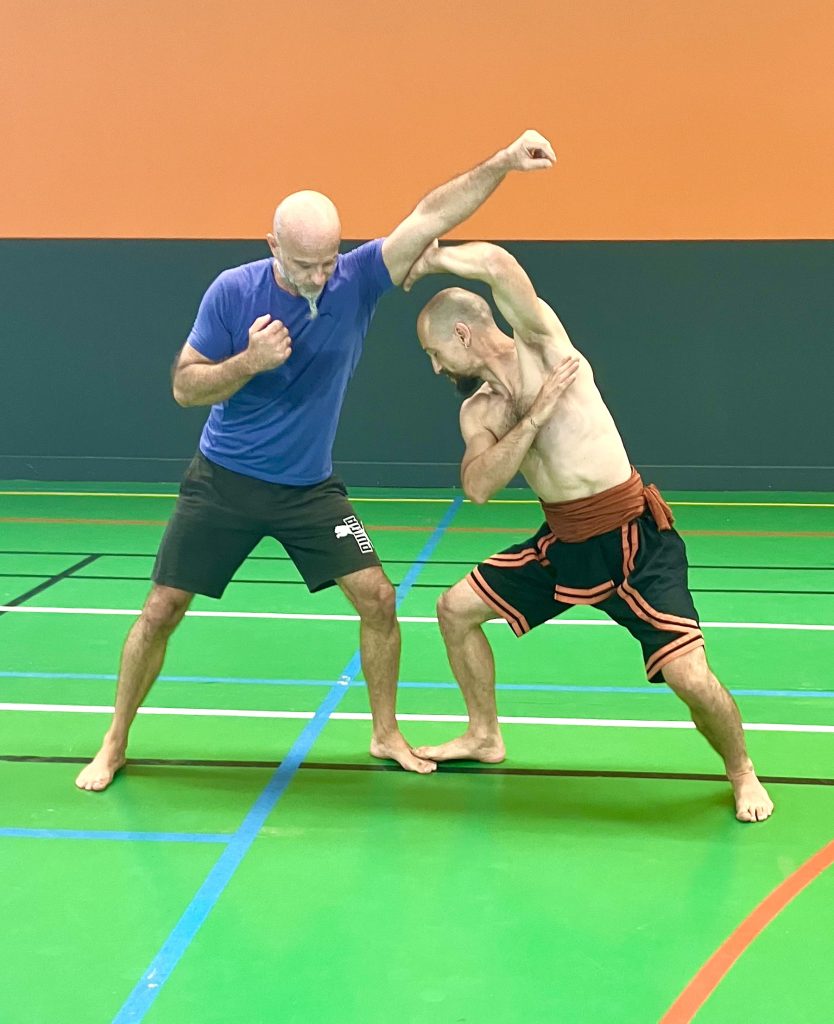
My teaching of bare-handed combat is mainly based on the Southern styles (Thekkan Sampradayanam / Marma Addi) and the Central styles (Madhya Sampradayanam / Kalam Chavitt), whose structures are inscribed in geometric figures (Yantra). The forms of these styles are relatively short; they combine sequences of strikes with patterns of movement, practised both alone and with partners. They also include combined combat exercises (Kai Poru), in which attention is placed on strengthening, the mudras used (hand positions), the different angles of strikes and counters, and the reactions to adopt when facing an armed opponent with empty hands.
A principial framework emerges naturally from these styles. I learned them as two distinct traditions, though some masters consider them to have a common origin in Tamil martial culture, of which the Thekkan Kalari is more clearly marked. The Central style (Madhya / Kalam Chavitt) comprises 64 Kalam (geometric figures on which the movements — Chuvadu — are based), which is not without recalling the 64 hexagrams of the Chinese Yi Jing, or again the 64 squares of the chessboard (invented in India). The structure of this style, which also includes “18 hands” and 96 Cheru Thozil (short exercises), is like a toolbox: a complete alphabet that only the most free and creative practitioners will be able to turn into complex, personal phrases. This approach has inspired me greatly, and more than fifteen years after being initiated into it I still draw new applications from combinations of the exercises I learned.
It is from the contact entries belonging to these two styles that I unfold the system of locks and throws whose ground seems common to the three styles I have studied. I also integrate physical preparations and combat conditioning more directly linked to the Northern style (notably pooli ankam — tiger combat of the Vaddakhan Sampradayanam) in the transmission of Verumkai Prayogam (bare-handed combat), which comprises many nuances and sub-categories of technique.
If I have taken liberty with the pedagogy I use to transmit these techniques, it is above all because I was already practising other martial arts and combat sports when I discovered Kalarippayattu. I have therefore sought to integrate all my martial skills and have always tested Kalarippayattu against other styles, for the sake of efficacy, and because combat is, in my view, a space where truth appears: it works or it does not, and it is impossible to cheat in an uncompromising exchange between martial artists. I therefore try to offer a teaching format that allows experienced martial artists to integrate what they have already acquired into an inclusive, principial system — more open than a traditionalist approach would be. (Note: by “traditionalism” I mean reproduction of the form with loss of the essence, as in folklore. For my part I consider that I keep a traditional spirit by using the form to bring out the essence, which is common to all styles and transcends them.)
Finally, it is important to distinguish the approach of a traditional martial art from that of a combat sport or of self-defence. There are many common points in the techniques and principles at work in all three, yet the state of mind cultivated in the practitioner remains very different. Traditionally there was no competition in Kalarippayattu, but only mortal duels between champions (Ankam), meant to settle a conflict without having to commit armed forces to a large-scale battle. The Kshatriya (warrior caste) practised their art knowing that it was a matter of giving or receiving death, most often in the service of a lord who was to be guided by the search for just action (Dharma). Under no pretext was this art to be used outside a framework dictated by moral rigour and the search for justice. Times have of course changed, and the Gurukkals saw the practice and transmission of their art forbidden during the English occupation, which certainly harmed its preservation. That said, the teachings were kept in secret, and contemporary Kalarippayattu is still imbued with strong moral values, largely influenced by epic narratives such as the Ramayana and the Mahabharata, whose heroes still serve as models today. Thus Kalarippayattu remains a path of realisation (Sadhana) for those who feel an affinity with the art of warrior-healers — and is no longer reserved exclusively for members of the warrior castes.
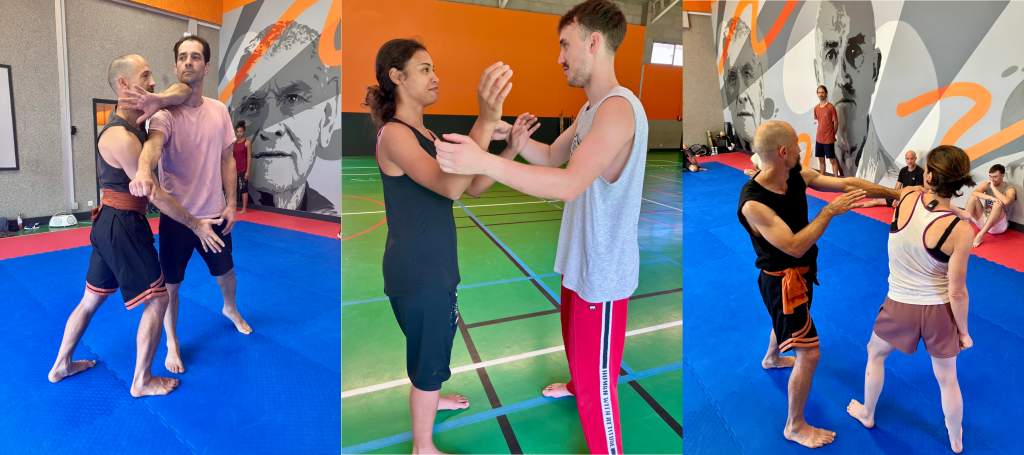
I myself try to walk this path, and I see the transmission of combat techniques first of all as a support for relational work: a situation of mastered tension is propitious for bringing out each person’s nature and for revealing how one reacts in the face of fear. The engagement expected of my students varies from one person to another and is progressive in intensity. The focus is placed first on relaxation, which must prevail in training to ensure self-control and everyone’s safety.
I also try to transmit the idea that a Sadhana must become a state of being and must not be limited to the hours of formal training. One is a martial artist at every moment, or one never is. If in life one flees before the first difficulty, it will be the same in the ring; training alone is not enough to forge a warrior’s mind. The school is life itself, and there are discreet combats, sometimes seeming trivial, from which one cannot withdraw if one wishes to hone oneself. The soul of a warrior must be like a blade which, once perfectly mastered, no longer needs to leave the scabbard. Martial presence is refined in daily life by meeting the challenges existence offers us. That is where the Greater Jihad of Islam resides — or, to put it otherwise, the inner combat each one must wage against his lesser self if he wishes to take a path of liberation.
This is how I conceive the spiritual dimension present in our art: bare-handed combat offers a real support for personal positioning and for relational work. I believe that every relation implies a relation of force — even unconscious, and even between those who are close and affectionate — and that to appease one’s relations first requires identifying the violence and the conflicts of which few of us are entirely free. Once recognised, this violence can be managed; one can learn to take one’s place in order to have one’s space respected, and also to see more clearly the intentions of others and to recognise more honestly those that inhabit us.
The direct character of body-to-body combat implies an engagement that sets the emotional dimension in motion, and our exercises bring states of being to light as they really are. In this the martial way is a trial of truth. Far from feeding aggressiveness, it makes it possible, on the contrary, to build sound cooperations, conscious of one’s strengths and of one’s limits.